The Local-Materials Myth: One Building Does Not Define a Region
The local-materials myth turns one building into a regional rule. Learn to read materials through availability, purpose, and period instead.
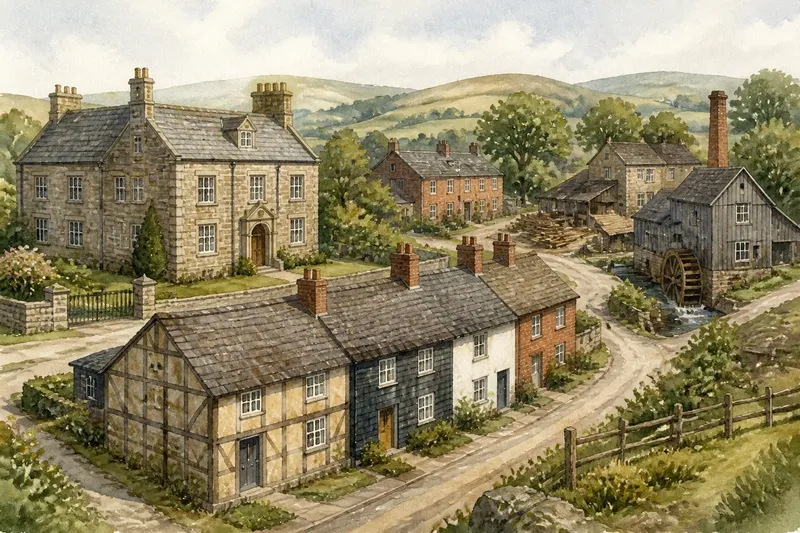
A stone farmhouse beside a timber mill can sit in the same valley without either being less local. The local-materials myth begins when one striking building is treated as the regional rule, as if its stone, brick, timber, or roof covering must explain every nearby structure. A better reading asks what materials people could obtain, what the building had to do, and when it was made.
This is a decision guide for looking at buildings in context. Start with the kind of evidence you have: one landmark, a cluster of similar structures, a building with a clear practical use, or a mix of older and newer work. Each situation calls for a different conclusion—and sometimes the most accurate conclusion is that the evidence is too limited to settle the question.
Are you looking at one landmark?
If your evidence is a church, manor house, station, or other prominent building, treat it as an individual example rather than a regional sample. Large or public buildings may have been built for a particular patron, budget, function, or moment. Their materials can reflect those circumstances as much as the resources of the surrounding community.
Notice what makes the building distinctive before deciding what it represents. A dressed-stone entrance may sit within a brick wall; a slate roof may cover a structure made of local timber; a later extension may use a different material from the original. Those contrasts are evidence of choices and changes, not a contradiction to smooth away.
Say you are walking through a fictional coastal village and spot a large stone hall among smaller timber cottages. If you record the hall as proof that the village is fundamentally a stone-built place, you have made one building carry too much weight. If you instead note the hall’s public role, its mixed construction, and the cottages nearby, your description can distinguish an exceptional structure from the ordinary local building stock.
Do several neighboring buildings share a material?
A repeated material is more useful evidence than a solitary example, but it still does not explain itself. Look for a group of buildings that share a material and ask whether they also share a purpose, location, or period. A row of brick workshops beside a railway may say something about an industrial district without describing nearby farms or houses.
Compare buildings that do similar jobs. Houses are most informative beside other houses; barns beside barns; shops beside shops. This is a fairer comparison than setting a barn against a civic building and assuming their different construction reflects a regional divide. Look at walling, roofing, foundations, and additions separately, since a building can combine materials for distinct practical reasons.
Then check whether the apparent pattern extends beyond one street or site. A cluster may mark a local building tradition, but it might also reflect a single development, a shared owner, or a concentrated building phase. Use restrained language: “common in this group” is more defensible than “the region’s traditional material” when your view is limited.
Is the building’s purpose shaping what you see?
Materials are selected for tasks as well as appearance. A storehouse, a dwelling, a workshop, and a place of worship face different demands. The need for a broad roof, a strong interior span, a protected entrance, or a surface that can be repaired locally may help explain why one building looks unlike its neighbors.
Read the building from the ground up, but avoid treating any single feature as a complete explanation. A stone base might meet the needs of a structure exposed to damp ground; a timber frame could suit a building that needed adaptable interior space. These are possibilities to consider, not conclusions to announce without supporting evidence. Ask what the material is doing and where it appears, then compare it with structures serving a similar purpose.
Be careful with decorative details, too. A polished stone doorway or patterned brickwork may show that a builder chose to make an entrance prominent. It does not establish that the same material was widely available or commonly used across the district. Visible expense and everyday construction are different kinds of evidence.
Could period explain the difference better than region?
Buildings in one place often belong to different periods, and construction choices change over time. New materials may become easier to obtain; older structures may be repaired or extended with whatever is practical at the time. A present-day street can therefore preserve several building moments side by side.
Look for clues that a building has been altered: a change in masonry bond, a seam in the wall, a blocked opening, or a roof that meets an older wall awkwardly. These features can suggest phases of work, although appearance alone may not establish when they occurred. A building that looks like an exception may be a later addition, a conversion, or a repair rather than evidence of a separate regional tradition.
When two neighboring structures differ, ask whether their dates or building histories differ before attributing the contrast to local resources. If you cannot establish their chronology, describe the visible difference without assigning a cause. That leaves room for a more accurate account later.
What should you conclude from the evidence?
What if I can see only one building?
Describe its materials and features as observations about that building, not as a rule for the region. You can say it is a stone farmhouse with a slate roof; reserve broader claims until you have compared it with other buildings serving similar purposes.
What if most nearby houses look alike?
You can describe a recurring pattern among the houses you can see, while keeping the claim within that group. The pattern may reflect shared construction, a common period, or a coordinated development, so avoid extending it to every building type in the wider area.
How can I tell whether a material is local?
A building’s appearance alone cannot establish where its materials came from. Treat “local” as a claim requiring evidence about sourcing or building practice; without that evidence, describe the material itself rather than its presumed origin.
What if a building has mixed materials?
Record the materials by part and note how they meet, rather than assigning one label to the whole structure. Mixed construction may reflect function, alteration, or distinct building phases, and those possibilities are more useful than forcing the building into a single regional category.
How should you describe a building on a local walk?
Write down what you can observe before adding an interpretation. A concise field note might identify the building’s apparent use, its main wall and roof materials, any visible additions, and the nearby structures you compared it with. Separate what is visible from what you infer: “brick wall with a timber upper floor” is an observation; “built this way because timber was scarce” is a proposed explanation.
- Name the building type: house, barn, workshop, or another visible use, while allowing for uncertainty.
- Describe materials by part: distinguish walls, roof, base, and later-looking additions.
- Choose a fair comparison: compare buildings with similar functions before comparing unlike structures.
- Keep the claim local in scope: identify whether you mean one building, a cluster, a street, or a broader area.
- Mark what remains uncertain: separate visible features from claims about source, date, or reason.
This approach makes a local-materials claim more useful, not less. Instead of presenting one familiar building as the face of an entire region, you can show how a building belongs to its immediate setting while leaving space for differences in supply, purpose, and period. The most revealing local pattern may not be one material at all, but the way neighboring buildings combine distinct choices.