The Layers Hidden in a Place Name
Learn how a place name changes in spelling and use, and separate documented clues from appealing guesses with a careful method anyone can follow.
Why does the same place appear under different spellings on an old sign, a parish record, and a current map? A place name can preserve several layers of local use: spoken forms, clerical spellings, administrative choices, and later reinterpretations. The changes are clues, but they do not all tell the same story.
To read those clues responsibly, distinguish what a source directly records from what someone infers from it. A document can show that a spelling was used at a particular time; by itself, it may not explain why it was chosen or what the name meant to the people who used it.
What can a changing place name reveal?
A changing spelling can reveal that a name passed through different hands and settings. A local clerk might write down a pronunciation in one way, while a mapmaker or government office later adopts a more standardized form. A printed version can then become familiar even if residents continue to say the name differently.
Names also change in use. A label once applied to a settlement may later refer only to a street, neighborhood, station, or landscape feature. Conversely, a district name can spread to nearby housing or a public facility. The label’s reach may shift without a dramatic change in its written form.
These patterns are useful evidence of naming practice, not automatic proof of a particular origin. Similar-looking words can have unrelated histories, and familiar modern spelling can tempt readers to connect a name to a present-day word that was not its source.
Why do spellings differ between records?
Older records often lack a single spelling convention for local names. A person recording a name might write what they heard, use a familiar spelling from another place, or follow the habits of a particular office. Handwriting, copying, printing, and later transcription can introduce further variation.
That means a spelling difference deserves attention, but not every variation marks a separate pronunciation or a change in local identity. Compare the source’s date, purpose, and context. A property deed, a postal directory, and a local sign were made for different tasks, so each may preserve a different version for practical reasons.
Keep the forms visible rather than silently replacing them with the current spelling. A simple note can record the exact version, where it appears, and the surrounding place description. That makes it easier to see whether a form recurs or appears only in a copied entry.
How can you tell a documented clue from a guess?
A documented clue is something a source directly supports: a recorded spelling, a stated boundary, or a label attached to a particular feature. An interpretation explains what that clue might mean. The interpretation can be plausible, but it remains an interpretation unless additional evidence supports it.
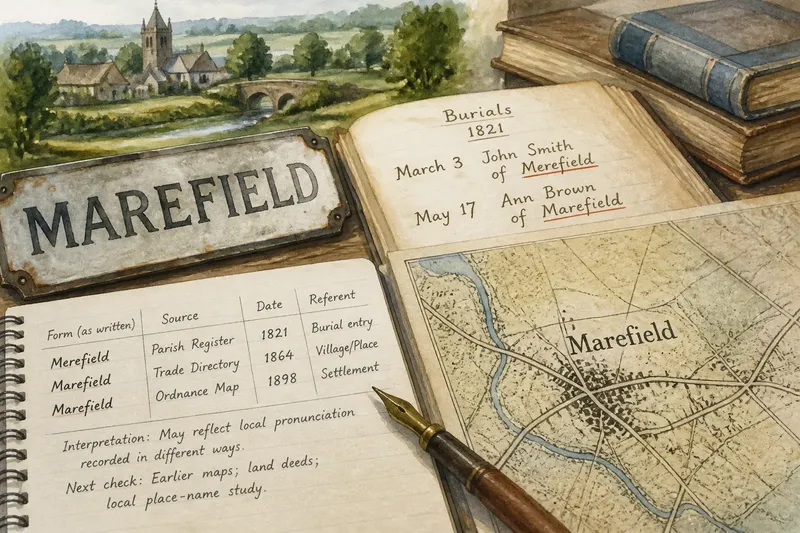
For example, imagine you find a local name written as “Merefield” in a directory and “Marefield” in a later map. The two forms establish a spelling difference. If you suggest that the name refers to a nearby wet meadow, that is a guess until a reliable source, local naming record, or consistent historical context connects the name to that meaning.
Try this compact evidence note:
- Record: Copy the spelling exactly as it appears.
- Source: Identify the record type and its date, if known.
- Referent: Note which place or feature the source labels.
- Interpretation: State what the form might suggest, using tentative language.
- Next check: Name the kind of evidence that could support or weaken the idea.
This separation keeps an appealing explanation from turning into a claim through repetition. It also leaves room for a better explanation if another record changes the picture.
Where should you look for earlier forms?
Start with sources that identify the place clearly, rather than collecting every similar-looking word you can find. Local directories, historical maps, parish or town records, property documents, and place-name studies may preserve different forms. A local library or archive can help identify which collections cover the area.
Check the record itself when possible. A transcription may normalize spelling, omit a marginal note, or misread a handwritten letter. If you use a digital map collection, inspect its catalog information and image, not just a search result or typed label. Record the location and context so another reader can tell which feature the name describes.
Compare forms in a modest sequence: the current name, the earliest clearly located form you can verify, and any intermediate versions that help explain a shift. “Earliest found” is safer than “original.” The oldest record you locate may postdate the name’s spoken use by a long time.
What questions help interpret a place name?
Does an older spelling prove the original pronunciation?
No. It records a written form, which may reflect one recorder’s habits rather than a precise account of local speech. Treat pronunciation as a separate question unless a source explicitly describes it.
Can a modern word explain an old place name?
It can suggest a possibility, but resemblance alone is weak evidence. Look for intermediate spellings and a credible explanation of how the name could have developed in that language and locality.
What if two sources give different locations?
Check whether the name shifted from a feature to a settlement, or whether the sources label different things with similar names. Note each referent separately instead of forcing them into one location.
When should an explanation remain uncertain?
Leave it open when the evidence supports several readings or lacks a clear connection between spelling and meaning. A careful account can say what is documented, describe the leading possibilities, and state what remains unknown.
How should you describe a name’s history?
Use wording that matches the strength of the evidence. “A map labels the area…” reports a record; “the form may derive from…” presents an interpretation. Avoid turning “could” into “does” just because one explanation sounds neat or fits the surrounding landscape.
Keep the place itself in view. If an old form labels a stream, explain that it applies to the stream in that source; do not assume it named the nearby village too. If the same name appears on both, the relationship may be meaningful, but it needs evidence rather than a shared label alone.
The layers hidden in a place name are most useful when their limits stay visible. Preserve variant spellings, identify what each source actually labels, and separate records from explanations. That gives neighbors a clearer account of how a familiar name was written and used—and a sound basis for deciding which parts of its story remain open.