Footpath or Minor Road for a Short Local Loop?
Choose a footpath or minor road for a short local loop by comparing surfaces, route continuity, traffic exposure, and the surroundings you want.
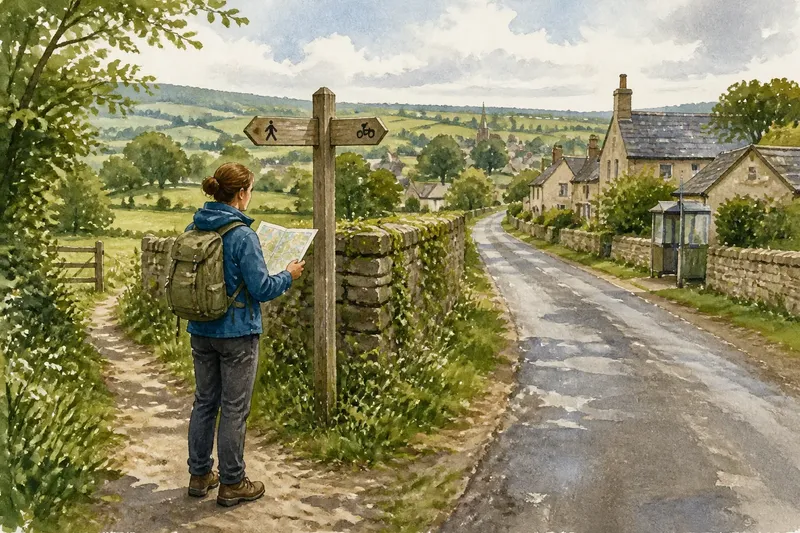
A footpath or minor road can both close a short local loop, but they make the walk feel different underfoot and along the way. To choose a footpath or minor road for a short local loop, look beyond the line on the map: check what the path connects, what its surface is likely to be, and whether the road offers a comfortable place to walk.
What kind of surface will you meet?
A mapped footpath may cross grass, packed earth, gravel, or a mixture. The line tells you where the route goes, not whether it stays firm after rain. Field edges can be muddy, while a gravel track may remain easier underfoot. A short walk can still feel demanding if the ground is slick or uneven.
A minor road usually has a more predictable walking surface, but “minor” describes its place in the road network, not necessarily its comfort for pedestrians. A narrow lane may have no sidewalk, and its edges can be rough, soft, or partly overgrown. Pavement also does not remove the need to watch for vehicles.
Match the choice to the day and your footwear. After wet weather, a surfaced lane may suit someone who wants to avoid muddy ground. In dry conditions, a clear footpath can offer a quieter, softer walk. If you are unsure, inspect the route on a local map and look for recent descriptions from a reliable walking or access source.
Does the route actually make a loop?
On a map, two lines can appear to meet while leaving a practical gap on the ground. A footpath may end at a field boundary, join another path through a gate, or emerge on a lane that must be followed briefly. A road loop may be straightforward to trace but include a stretch with little room to step aside.
Check junctions and transitions, not just the broad shape. Note where a path meets a road, whether the crossing is clear, and how the return leg reconnects. On a printed map, trace the line with a finger; in a mapping app, zoom in enough to distinguish a mapped path from a boundary or driveway. If access or current conditions are unclear, seek local information rather than assuming the map settles the question.
Say you want a short circuit from a village green and the map shows a footpath out to a lane, then the lane back toward the green. If the path’s exit is easy to identify and the lane has room to walk attentively, that combination may give you a quieter outward leg and a more legible return. If the path is hard to follow or the lane feels exposed, choose another loop rather than forcing the connection.
What surroundings do you want from the walk?
Footpaths often bring a walker close to boundaries, gardens, fields, or the edges of woodland. Their appeal may lie in small changes of view: a stile, a hedge gap, or a glimpse between buildings. Those details depend on the setting, and a footpath is not automatically scenic; it can also be enclosed or visually plain.
A minor road can reveal a different pattern of local life. It may pass cottages, farms, a bus stop, or a junction that links neighboring settlements. The route may offer longer views, but also more traffic noise and fewer places to pause. Think about whether you want close contact with the landscape or an easy-to-read line through inhabited surroundings.
Keep to the public route and respect gates, signs, and private entrances. A mapped footpath is not an invitation to wander into adjoining land, while a road passing a house does not make its driveway part of the walk.
What should you check before choosing?
- Surface: Is the path likely to be muddy, stony, or uneven, and does that suit your shoes?
- Continuity: Can you trace every junction and the return leg without relying on an unclear connection?
- Room to walk: Does the road have a verge or another comfortable margin, or would you be close to traffic?
- Visibility: Are bends, hedges, or parked vehicles likely to limit sightlines?
- Access: Are gates, signs, or local access information consistent with using the route?
- Setting: Would you rather pass through open ground, follow a lane past homes, or combine both?
Use the answers to choose the route that fits today’s conditions, not a rule that one type is always better. Where access depends on a sign, map label, land manager’s information, or local rule, follow that guidance.
Which route questions matter most?
Is a footpath always quieter than a road?
Not necessarily. A path may run close to a busy road or meet it at several points, while a minor road may carry little traffic at the time of your walk. Check the route’s setting and use your judgment rather than relying on its map symbol.
Can I follow a footpath in ordinary walking shoes?
That depends on the surface and recent conditions. Firm gravel or a dry, even track may be comfortable, while wet earth or rough ground can call for footwear with more grip and support.
What if the mapped path seems blocked?
Do not climb a fence, force a gate, or cross land to keep the loop intact. Turn back or use a clearly accessible alternative, then check current local access information before choosing that route again.
How do you make the final choice?
Choose the footpath when its connection is clear, its ground suits the day, and the closer landscape is part of what you want from the walk. Choose the minor road when a steadier surface and an easy-to-follow line matter more, provided you are comfortable with its traffic and walking space. A loop can also use both, with each leg selected for a different reason.
Before setting out, keep the map available and notice a landmark near the point where the route changes from path to road. That small reference makes it easier to recognize the junction on the ground and adjust calmly if the route does not match your expectations. For a footpath or minor road loop, a good choice is the one whose surface, connections, and surroundings suit the walk you actually want today.